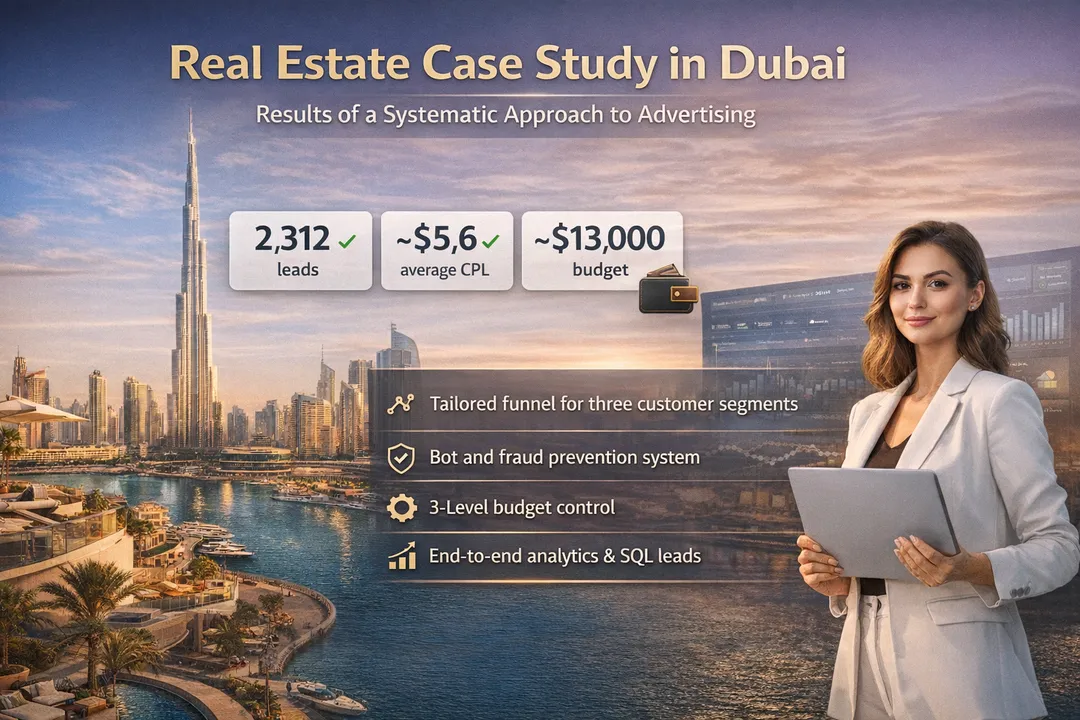
My name is Czeslaw. I represent the marketing agency Welcome Leads, which specialises in marketing for real estate agencies and developers.
This case study showcases the lead generation results obtained by exclusively through Facebook and Instagram, on a real project in Dubai, without embellishing the figures and with a focus not only on the cost of the application (CPL) but also on the quality of leads and the economics of the entire funnel.
👉 I regularly publish some of the practical solutions, mistakes and working bundles on my TG-channel. subscribe to Telegram, there's more practice and more numbers.
🎯 Project baseline data
The client is a real estate agency handling properties in Dubai and other emirates of the UAE.
It's important to realise: Dubai is a market where:
- a lot of competing agencies,
- adverts are expensive and overheated,
- a huge number of «empty» requests (people click but do not buy),
- a buyer can think about buying for months.
The client already had:
- sales managers,
- CRM system (the programme where leads go so they don't get lost),
- understanding that advertising should bring not just applications, but customers.
The main objective
Make an advertising channel that gives:
- a flood of applications every day,
- an understandable cost of treatment,
- and most importantly, quality, so that requests turn into deals.
🧭 Stage 1: Analytics and strategy - the foundation of results
This is the stage we consider critical.
This is where 70-80% of the future result is laid down, even before the first advert is launched.
Most failed launches in property are not due to bad adverts, but to a lack of strategy: when adverts are launched «blind», without understanding the market, the audience or the logic of the deal.
In this project, analytics and strategy became the foundation for all future work.
An in-depth analysis of the Dubai property market
We conducted a comprehensive market analysis before launching the adverts:
- explored Facebook and Instagram advertising libraries, to understand:
- which offerers are already «overheated»,
- what wording your competitors are using,
- which visual patterns repeat most often;
- analysed agency positioning:
- who sells investments,
- who emphasise living in Dubai,
- who work with the premium segment;
- rated level of confidence In the adverts:
- if there are specifics,
- if the client's path is explained,
- if the logic of the purchase is clear.
The conclusion was obvious: the market is oversaturated with identical promises and lacks structured, understandable offers.
Strategic segmentation of the target audience
Instead of trying to «sell to everyone,» we strategised through segmentation.
It's important because:
- an investor and a buyer for life make decisions for different reasons,
- different segments respond differently to advertising,
- Mixing audiences almost always leads to higher CPLs and lower lead quality.
Three key segments have been identified as part of the strategy:
- Investors
Focus on capital preservation and growth, liquidity, exit scenarios. - Buying for life
People who choose Dubai as a place to live and not just as an investment. - Second home / diversification
Buying property as an additional asset or reserve.
Each segment had its own communication logic, offerers and customer expectations.
Selecting a platform and engagement logic
Based on the analysis, a strategic decision was made to use exclusively Facebook and Instagram as a major source of applications.
Why it's important:
- platforms allow for rapid hypothesis testing,
- are easily scalable,
- give a steady stream of requests when properly configured.
Engagement Format:
- On-Facebook Lead Forms - in-built application forms within the platforms.
The lead's journey was laid out as transparently as possible:
advert → application form → CRM → qualification → sales work
This structure made it possible to count not only the cost of the application (CPL) but also the the real business value of each lead.
🎨 Step 2: Creatives and Offers - Managing Attention and Expectations
In real estate, advertising creative fulfils two functions at once:
- Attracts attention in the tape.
- Shapes the expectations of the customer before he even leaves the application.
If a mistake is made at this stage, the adverts may generate many bids, but the quality will be low. Therefore, the creatives and offers in this project were not considered as «design», but as a tool for filtering and managing lead quality.
Why we only used static images
Within this case study, we deliberately eschewed video and used a purely static creatives.
Reasons for this decision:
- static images give a more stable conversion rate to an application,
- it's easier to control the meaning and the promise,
- less distortion of customer expectations,
- It is more convenient to scale working bundles.
For the Dubai property market, this has kept a balance between the volume of applications and their quality.
Offeree strategy: not one-size-fits-all
Instead of a one-size-fits-all offer, we've built a system of offerers for different buying scenarios.
Each offer answered the customer's main question:
«Why should I leave an application now?»
Offers were developed for three key segments:
- Investors
Emphasis on deal logic, liquidity, exit scenarios and a clear buying structure. - Buying for life
Emphasis on neighbourhoods, infrastructure, livability and everyday property value. - Second home / capital diversification
Real estate as a reserve asset and capital preservation tool.
This allowed us to immediately attract more informed customers and reduce the proportion of casual applications.
The «fair offerer» principle»
We deliberately avoided:
- aggressive investment promises,
- «guaranteed income» language,
- vague slogans with no explanation of the process.
Instead, in creatives:
- explained the buying scenario,
- trust was formed,
- set the right context for further communication with the manager.
This approach reduces the number of «empty» requests, but increases the share of quality leads.
The role of creatives in reducing the cost per lead
Expertly assembled creatives made it possible:
- hold CPL in the range $4.43-$8.16,
- avoid cost spikes when scaling up,
- stabilise the flow of applications on the course.
It's important to realise:
the low CPL in this case study is. investigation of strategy and offers, not an accident or a «lucky picture».
Why this step is critical to the outcome
If the creatives and offerers aren't well thought out:
- adverts are starting to attract random people,
- there's an increasing pressure on the sales team,
- the conversion to deals is dropping.
In this project, it was the systematic work with creatives that made it possible:
- retain the quality of leads,
- ensure scalability,
- to build a stable advertising channel.
👉 If you want your adverts to bring in customers, not just applications, creatives and offerers should be part of the strategy, not a random element.
🔧 Stage 3: Launching advertising campaigns and optimisation - budget control without chaos
One of the main reasons for distrust of property advertising is the fear of draining the budget.
In this project, we initially structured the process in such a way that the money wasn't spent blindly, and every campaign was monitored.
The launch and optimisation of advertising was built on 3-level control system, which allows you to stop ineffective campaigns in time and strengthen working links.
Level 1. Control at the stage of campaign launch
Even before the adverts started to scale, automatic rules were set up that:
- tracked key metrics immediately after launch,
- automatically deactivate campaigns and ad groups if they do not meet the specified cost and response benchmarks.
Simply put, if the bundle showed no signs of life, it was stopped automatically, without waiting to see if it gets better tomorrow.
It allowed:
- to avoid blowing the budget at the start,
- to quickly weed out weak hypotheses,
- to focus only on promising options.
Level 2. Control of optimised campaigns
Separate monitoring rules were in place for campaigns that had already passed the initial screening and shown working results.
These rules are:
- monitored the deterioration in performance,
- responded to the rise in CPL,
- shutting down or limiting campaigns if results started to slip.
It's important that we didn't wait for the problem to become critical.
The control was triggered early, keeping the budget and stability in place.
Level 3. Regular manual monitoring and analytics
Automation is a tool, but not a replacement for analytics.
Therefore, the third level of control was weekly manual analysis.
Every week we:
- analysed campaign data,
- looking at the dynamics of lead quality,
- to see how advertising affects the sales team,
- made decisions on budget reallocation.
It was the manual control that allowed it:
- to see the whole picture,
- to adjust strategy,
- to prevent the accumulation of errors.
Why such a system works
The combination of automatic rules and regular analysis had a key effect:
- the budget is not «leaking» to ineffective campaigns,
- advertising remained manageable,
- could be scaled without risk.
Through this approach it has been possible to:
- hold CPL in the range $4.43-$8.16,
- get a steady stream of applications,
- to work at a distance, not in short bursts.
👉 If you are afraid of budget drain and chaotic advertising, The control system is what distinguishes a professional approach from random launches.
⚡ Stage 4: Launch and the first 72 hours - the point where the fate of the budget is decided
The first 72 hours after an advert is launched is the most sensitive stage.
It is during this period that it becomes clear which hypotheses have potential and which ones should be switched off without regret.
We don't see the launch of an advert as a «let's wait a couple of days and see».
From the first hour, the launch is constantly monitored.
What happens in the first 24 hours
Already in the course of first 24 hours after the launch:
- the first applications started coming in,
- it became clear which audience segments responded better,
- the first benchmarks for application costs and response rates have emerged.
This allowed us to immediately screen out options that:
- didn't get involved,
- were overpriced,
- did not meet the specified KPIs.
Active mini-sections every 6-8 hours
For the first 3 days, we spent regular mini-sections every 6-8 hours.
In these stages:
- analysing campaign performance,
- overpriced bundles have been switched off,
- reallocated the budget in favour of the best ads.
Such a regime allows:
- prevent losses from accumulating,
- to quickly strengthen the working ligaments,
- stabilise the outcome at an early stage.
Why it protects the budget
The main mistake of most launches is the lack of response in the first few days.
That's not how we operate:
- we don't wait «for the algorithms to learn» without control,
- don't keep weak campaigns out of hope,
- do not increase budgets until we have proven results.
Thanks to this:
- the budget doesn't drain,
- adverts get to performance figures faster,
- scaling starts based on data, not guesswork.
The result of this approach
Control in the first 72 hours allowed:
- to quickly identify promising bundles,
- to maintain a stable CPL,
- lay the groundwork for long-term work.
It is at this stage that advertising ceases to be an experiment and becomes a a manageable customer engagement tool.
👉 If you want the advertising to not «learn at your expense», but immediately work under control, proper operation in the first 72 hours is critical.
📟 Step 5: Cross-cutting analytics and quality control
The outcome of the project was made possible by the bundle:
Facebook / Instagram → CRM → end-to-end analytics
What did it do
We saw it:
- how much each application costs (CPL),
- which applications move to qualified status,
- Which ad bundles yield real customers.
We've optimised the advertising not by the number of applications, but in the quality of leads.
📊 Results for 9 months (2024)
The results in this case study are not a one-off «shot», but the result of systematic work: analytics, strategy, budget control and constant optimisation.
Below are the key project indicators from January to September 2024.
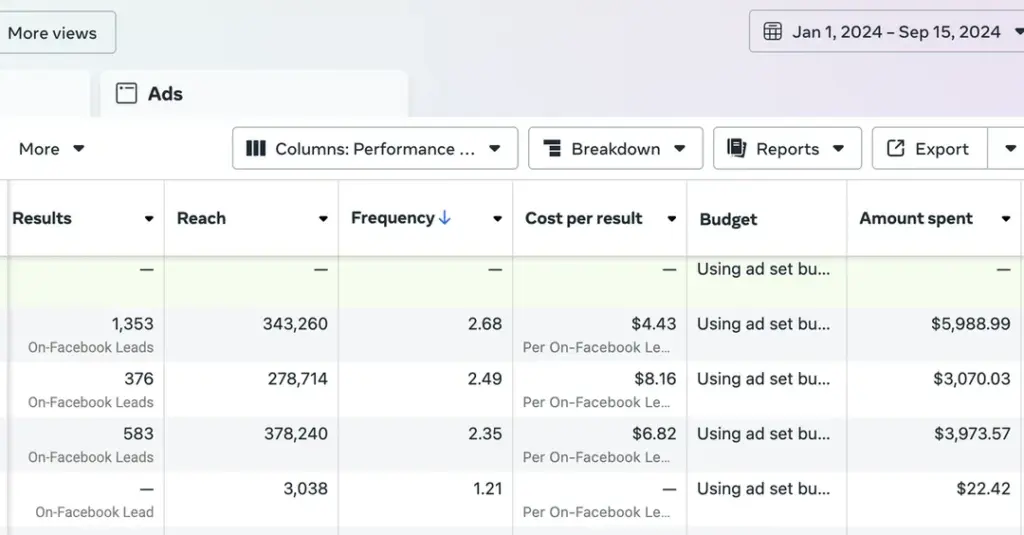
- Key Indicators
- Total applications: 2 312
- Advertising budget: ~$13 000
- Cost of the application (CPL): $4.43 to $8.16
- Average CPL by project: ~$5.6
- Scope: more than 1,000,000 people
- Average display frequency: 2.3-2.7
- Sources of applications: exclusively Facebook and Instagram
(without connecting other advertising channels).
Quality of applications
It is not only the number of applications that matters, but also their quality.
According to CRM and analytics:
- 21% applications had a real interest in buying the property (qualified),
- customers were considering a purchase in the horizon up to 6 months,
- the sales department received potential customers rather than casual enquiries.
This means that the adverts were not working for «masses» but for real demand.
Project economics in simple terms
If you translate the numbers into understandable logic:
- for ~$13,000 advertising budget.
- the client received more than 2,300 references,
- of which 480 leads were potentially ready to make a deal.
Unfortunately, we are not aware of the number of transactions, but I am sure that our co-operation would not have lasted so long if the sales figures were low.
Therefore, for the Dubai property market in 2024, it is a strong and sustainable result.
📈 The context of 2026 and the relevance of Facebook and Instagram
It is important to realise that the property market in 2026 is noticeably more complex than it was a few years ago.
It's not just the algorithms of advertising that are changing, but also the customer behaviour.
What happens to the market in 2026
In reality, we see several consistent trends:
- bid price rises in almost all geographies,
- the market becomes even more superheated,
- the number of people willing to make a quick deal is shrinking,
- the decision cycle becomes longer,
- customers are more likely to compare, doubt and «mature» over time.
This means that the simple scheme «run adverts → get applications → sell» is working worse and worse.
Why without warming up and branding the result sags
In 2026, property advertising is increasingly demanding:
- warm-up pits, not single touches,
- regular contact with the audience,
- building trust in the agency's brand,
- of expert content, not just offers.
People want to understand:
- who you are,
- why you can be trusted,
- how you're different from dozens of other agencies.
Without it, any bids convert poorly into deals.
The problem of lead forms in 2026
That said, the lead form format is still a massive and convenient format, but it has its limitations.
In 2026, we see that:
- lead forms are more susceptible to bots and frood,
- increased volume automatic and random bids,
- unfiltered lead quality drops dramatically.
Yes, this tool is getting worse in overheated markets. That's why we've developed own product, which cuts off more 82% bots, spam and frod. And yes, it's free for all of our customers.
Why Facebook and Instagram still work
Despite the difficulties, Facebook and Instagram are still some of the most effective channels for property in 2026.
The reasons are simple:
- the sheer volume of the audience,
- the ability to work with different segments,
- scalability.
The only difference is that now it is not those who «spin the adverts» who win, but those who build the system.
Key takeaway
In 2026, property advertising is no longer about «cheap leads».
It's about:
- system,
- quality control,
- warming up,
- analytics,
- trust work.
That's why even in the current environment, it's possible to get quality applications and scale - if the right approach is taken.
📌 Conclusion
This Dubai case is the result strong teamwork, not a happy coincidence.
On the client's side:
- CRM system has already been implemented,
- the team was willing to work with analytics, not just the number of applications,
- The sales team actively gave feedback and participated in process improvements.
This is important because without customer engagement, even the best advertising won't produce consistent results.
On the part of our agency:
- systematic lead generation via Facebook and Instagram,
- end-to-end analytics and quality control of leads were implemented,
- budget protection system is set up and optimisation is not based on CPL, but on the real value of a lead,
- The economics of the transaction are recorded and understood, not just the numbers in the advertising office.
This is what projects that range, rather than being fired once.
If you want to:
- realise real customer value, not just the bid price,
- to see not just applications, but their quality and bargaining potential,
- to scale advertising in Dubai without chaos and with budgetary control,
This approach yields maximum results even in an overheated market.
P.S..
If you are selling a property in Dubai or UAE and want to:
- to stop focusing only on the CPL,
- build a sustainable lead generation system,
- Receive applications that actually make it to deals,
leave a request on the website or write to us.
I'll take your project apart, show you real numbers, and offer solutions that will operating in 2026, not in theory.
That's how collaboration that gets results begins.
❓ Frequently Asked Questions on Leads in Real Estate in Dubai
How much does it cost to apply to buy a property in Dubai?
Currently, prices range from 15-30$ per lead.
But the cost-per-application (CPL) depends on many factors: audience segment, the offerer, competition and the current market situation.
In this case:
- CPL was in the range of $4.43-$8.16,
- The average figure was about $5.6.
It's important to realise that the goal is not a minimum CPL, It's about getting bids that have the potential to go through to a deal. That is why we always consider the economics beyond the first click.
Why might the bid price increase over time?
In 2026, this is a normal market process:
- Dubai's property market is overheated,
- competition between agencies is growing,
- ad auctions are getting more expensive,
- people take longer to make decisions.
CPL growth is not a sign of bad publicity, but a signal that the We need to change strategy, increase warming and filtration., and not just «spin the adverts».
What is the cost of a qualified lead for Dubai?
In this 2024 case study, the cost per qualified lead (SQL) was about $67.
In 2026, with a properly assembled bundle of advertising, filtering, sales and analytics, we have projects where the value of a qualified lead across Dubai is as high as $102.
The key is a system, not a single tool.
Do Facebook and Instagram work for real estate in Dubai in 2026?
Partially, yes.
In 2026:
- the number of automatic applications increased,
- spam and phreaking have increased,
- Without filtering, lead forms quickly lose quality.
That's why we're using own product, which:
- cuts off more 82% bots and low-quality bids,
- allows you to optimise advertising not by CPL, but by SQL,
- maintains quality even as traffic increases.
This tool and end-to-end analytics enter the work for free for our clients.
How long does it take to see the first results?
The first applications tend to appear within 24 hours after the launch of the advert. Preparatory work on average takes 5-7 days from the moment payment is received.
But it's important to realise:
- stability is not formed in a day,
- the first 72 hours is the active monitoring and optimisation phase,
- The full picture of quality can be seen after a few weeks of work.
We always explain to clients what to expect and at what stage.
📌 How do you get in touch with me?
Want to replicate the result for your agency or developer - write, we will put together a quality plan just for your purposes.
And don't forget to subscribe to the Telegram channel with practice and cases 👉 Welcome Leads in Telegram.



 WhatsApp channel