


My name is Czeslaw. I represent a marketing agency Welcome Leads, which specialises in lead generation and marketing for estate agencies and developers.
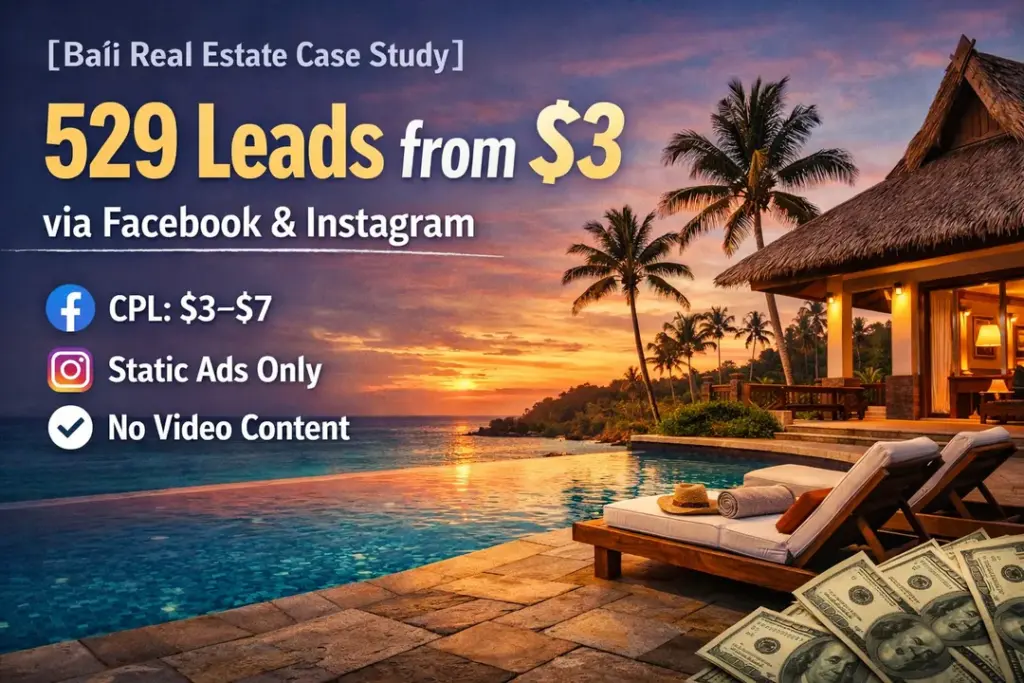
This case disassembles a real estate project in Bali (Indonesia). All results are obtained exclusively through Facebook and Instagram, without embellishing the figures and without additional traffic channels. The main emphasis is on cost per claim (CPL) and stability of the result within the real 2023 project.
We show what lead generation in property looks like when advertising is built not on «lucky tweaks» but on a clear strategy, control and systematic work that can be repeated and scaled.
👉 I regularly publish some of the practical solutions, working bundles and conclusions from such projects in my Telegram channel. There's more practice, real numbers and observations from property launches in different countries.
🎯 Project background and context
Before launching an advert, it is important to understand the environment in which the project is operating.
The Bali property market in 2023 looked attractive, but in practice had a number of features that directly affected the advertising result.
Bali Market Context
At the time of launch, Bali was one of the most talked about regions for overseas property investment:
- active inflow of investors from different countries,
- growth in rental demand,
- comparatively low entry threshold compared to Europe and the Middle East,
- a large number of agencies working with similar offerers.
At the same time, the market could not be called «simple».
Most agencies faced the same problems:
- formulaic sentences,
- lack of clear audience segmentation,
- sharp spikes in the cost of bids,
- unstable quality of leads.
What the client came with
The client is a real estate agency working with properties in Bali.
At the start of the project:
- there was no stable advertising channel,
- Facebook and Instagram were seen as the main source of leads,
- it was important to realise, whether applications can be received systematically, not one-off bursts.
The client already had a basic process for handling leads, so the focus immediately shifted from «get leads at any cost» to an understandable and controlled economy.
Project Objective
The main objective was not formulated in the format of «get as many applications as possible», but much more precisely:
- Test Facebook and Instagram as a stable channel,
- Receive bids at an adequate cost,
- to keep CPL within the projected limits,
- avoid chaotic launches and cost spikes.
It is precisely this formulation of the task that made it possible to build a systematic work and lay the foundation for further stages.
Why this step is important
If you skip the step of capturing the raw data and context:
- advertising becomes an experiment,
- the result is hard to replicate,
- Scaling becomes a risk.
In this case study, a clear understanding of the starting conditions was the point from which the entire lead generation strategy was built.
🧭 Step 1: Analytics and strategy - the basis for a manageable outcome
We always treat analytics and strategy not as a formality before launching an advert, but as a key stage, which directly affects the final result.
In practice, it is errors at this stage that most often lead to:
- an increase in the cost of bids,
- unstable lead quality,
- inability to scale.
In the Bali case study, analytics and strategy became the foundation for all future work.
Bali property market analysis
Before launching the adverts, we carried out a detailed analysis of the market and the current advertising environment:
- studied the advertising libraries of Facebook and Instagram,
- to see what offerers and wording agencies are using,
- assessed the visual style and structure of competitors' adverts,
- analysed which meanings are repeated and stop working.
As a result, it became obvious:
market was overloaded with one-size-fits-all offers, and most agencies spoke the same language to the audience.
This created two problems:
- users would quickly stop responding to the adverts,
- the cost of the application was rising for no obvious reason.
Searching for growth points and «white spots»
Special attention was paid to finding so-called «white spots» - areas that competitors either ignored or worked on superficially.
We've got it fixed:
- Lack of a clear explanation of the buying scenario,
- weak segmentation by customer objectives,
- A focus on promises instead of the logic of the deal.
This became the basis for the future offeer and communication strategy.
Strategic audience segmentation
Instead of trying to appeal to everyone at once, we divided the audience into key segments based on purchase incentives, not demographics.
Major segments:
- Investors
What matters to them is rental income, prospects for value growth and a clear ownership scenario. - Buy to let
Clients focused on recurring revenue and payback. - A second home or a move
Buying a property for living or long term residence in Bali.
Each segment required a different communication logic, so the strategy was initially built as a multi-scenario, not a one-size-fits-all.
Channel selection and engagement logic
Based on the analyses, it was decided to use exclusively Facebook and Instagram As a primary channel for lead generation.
Reasons for selection:
- high concentration of the target audience,
- The ability to test hypotheses quickly,
- Scalability without dramatic cost increases.
Engagement Format:
- On-Facebook Lead Forms - in-built application forms within the platforms.
The lead's journey has been simplified as much as possible:
advertisement → application form → processing of the application by the sales department
It allowed:
- Reduce barriers for the user,
- Increase conversion to application,
- to keep CPL within controlled limits.
Why this step is critical
If adverts were launched without this stage:
- the result would be random,
- an increase in the budget would lead to an increase in the CPL,
- scaling up would become risky.
It was the analytics and strategy that made it possible:
- lay down a sustainable model of engagement,
- Understand the limits on the cost of the application in advance,
- to build a controlled process, not an experiment.
👉 If you want to receive applications consistently, not «catch a lucky month», It is with analytics and strategy that advertising should begin.
🎨 Step 2: Creatives and offerers - audience filtering
In real estate, creatives and offfers perform more than just an attention-grabbing function.
Their key objective Create the right expectations for the customer and weed out untargeted audiences before they even leave a request..
In this Bali case study, we initially set up the work so that the ad would not drive the maximum number of clicks, but rather the informed requests.
Restrictions at the start and how we dealt with them
In the initial phase, the client has it was not possible to produce quality content on a regular basis:
- there were no finished videos,
- there were no professional photo shoots,
- didn't have the resource for sophisticated visual material.
We put this limitation in the strategy from the beginning, rather than seeing it as a problem.
Why we only used static creatives
Given the starting conditions, a conscious decision was made to use a purely static advertising images, without video content.
This approach allowed:
- Not to be dependent on content production,
- Run and test hypotheses faster,
- Control the meaning and expectations of the client,
- Hold a steady conversion to application.
For the Bali market in 2023, static creatives have performed as predictably as possible in terms of bid value.
Logic of working with offers
We didn't use a one-size-fits-all «for everyone» offerer.
Instead, the offerings were built around purchase incentives, identified in the analytics phase.
Main scenarios:
- Property investment in Bali
Emphasis on rentals, tourist demand and long-term interest in the region. - Buy to let
For clients who see property as a source of regular income. - A second home or a move
Focus on lifestyle, climate, infrastructure and long term living.
Each offer answered the customer's main question:
«Why do I need a property in Bali and what task does it solve?»
The principle of honest and straightforward communication
We deliberately avoided:
- aggressive investment promises,
- formulations with guaranteed returns,
- pressure and artificial deficits.
Instead, in the adverts:
- explained the buying scenario,
- simple and clear language was used,
- created a context of trust in the agency.
This approach reduces the number of random requests, but increases the quality of the incoming stream.
How did it affect the outcome
Even without sophisticated content and video creatives, it succeeded:
- keep the CPL in the range $3-7,
- to avoid spikes in value,
- ensure a steady flow of applications.
It's important to emphasise:
result was achieved not at the expense of content, but through strategy, segmentation and control.
Why this stage is critical
If the creatives and offerers aren't well thought out:
- adverts start to attract a casual audience,
- there's an increasing pressure on the sales team,
- the channel's credibility goes down.
In this project, it was the proper handling of offers and client expectations that made it possible:
- to keep it manageable,
- to keep a predictable CPL,
- prepare the project for further development.
👉 If you don't have the resource to produce content right now, that's no reason to put off advertising.
With the right approach, results are possible even under such conditions.
🔧 Stage 3: Launching advertising campaigns and optimisation - control instead of chaos
After preparing the strategy and creatives, we moved on to launching the advertising campaigns.
At this stage, our key objective was not just to receive applications, but to keep the process under control from the beginning and prevent the budget from being drained.
In the Bali case study, the launch was built as a managed process, not as a «let's see what happens» experiment.
How the launch of advertising campaigns was organised
The advert was launched with the aim of Leads (Form) - that is, the Facebook and Instagram system has been optimised specifically to receive applications.
The launch structure included:
- several campaigns in parallel,
- separate groups of adverts for different audience segments,
- A gradual distribution of the budget without sudden increases.
We didn't run «one button» adverts or put large budgets all at once.
This allowed hypotheses to be tested quietly and kept things manageable.
Budget control system during the start-up process
In order to avoid the typical situation when the budget is spent on inefficient bundles, it has been built multilevel control system.
First level - control at the start
Immediately after the launch, we tracked:
- audience reaction,
- first applications,
- the dynamics of the cost per lead.
If the bundle:
- didn't get a response,
- was showing an inflated CPL,
- was not in line with the benchmarks,
she switched off without expectations or «assumptions».
The second level is the control of campaigns already in operation
For campaigns that showed a working result, the control was not relaxed.
We're regular:
- tracked the rising cost of the application,
- monitored the frequency of the shows,
- to check the stability of the response.
If performance began to deteriorate, budgets were adjusted or bundles were stopped until the situation was clarified.
Level three - regular manual analysis
In addition to automatic decisions, an important role was played by manual control.
We're regular:
- analysed the overall picture of the campaigns,
- looking at the dynamics by segment,
- made decisions on budget reallocation.
This allowed you to see not individual numbers, but complete system.
Why this approach is particularly important for Bali
Bali's market is sensitive to:
- the frequency of the shows,
- to the same type of offerers,
- to drastic changes in the budget.
Without control, adverts burn out quickly and CPL starts to rise for no apparent reason.
System start-up and optimisation allowed:
- keep the CPL in the range $3-7,
- avoid sudden spikes in value,
- to maintain a consistent result over the course.
Outcome of the start-up and optimisation phase
This phase showed that:
- even without sophisticated content,
- without big budgets,
- without drastic scaling
can be built stable advertising channel, if the process is manageable and transparent.
👉 If you're afraid of a budget drain or chaotic launches, It is this approach to start-up and optimisation that keeps control and results in check.
⚡ Step 4. First 72 hours after start-up
The first applications have started to come in within the first 24 hours.
In the first 72 hours:
- regular cut-offs for indicators were conducted,
- ineffective adverts were switched off,
- the budget was reallocated in favour of the best bundles.
This approach allowed us to quickly reach operational performance and avoid unnecessary costs.
📊 Project results
Totals
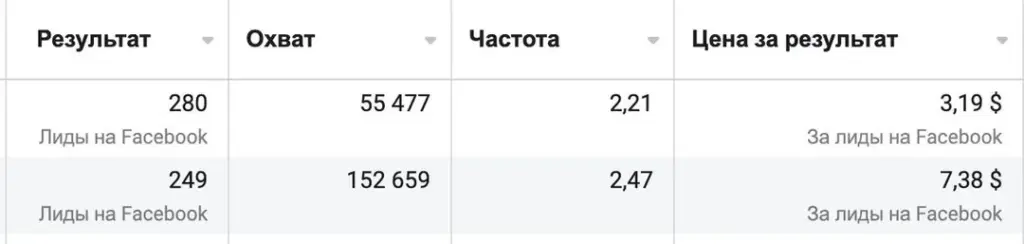
- Lidov: 529
- CPL: $3.19 - $7.38
- Frequency: 2.2-2.5
- Scope: 200 000+
For the Bali market in 2023, it was a stable and predictable result.
Why the result was
- a clear strategy without complications,
- clear audience segmentation,
- simple and honest offsets,
- control at all stages of the launch.
📌 Conclusion
This 2023 case study on attracting potential clients to buy Bali property is an example of how to systematic approach gives results even without sophisticated tools.
On the client's side:
- Willingness to test adverts,
- involvement in the process,
- prompt processing of applications.
On the part of our agency:
- a structured strategy,
- control of start-up and optimisation,
- The understandable economics of lead generation.
This is what projects that are repeatable and scalable look like.
P.S..
If you are selling property in Bali and want to:
- to stop focusing only on the CPL,
- build a sustainable lead generation system,
- Receive applications that actually make it to deals,
leave a request on the website or write to us.
I'll take your project apart, show you real numbers, and offer solutions that will operating in 2026, not in theory.
❓ Frequently asked questions about property lead generation in Bali
How much does it cost to apply to buy a property in Bali?
Within the framework of the of this case study on Bali (2023):
- the cost of a bid (CPL) was in the range of $3-7,
- adverts were run through Facebook and Instagram,
- only static creatives were used.
For the Bali market in 2023, it was a very competitive and sustainable, achieved through strategy and control rather than aggressive promises.
What are the current application prices for Bali in 2026?
The market has changed significantly and it is now important to consider audience language.
According to our current data for Bali on 2026:
- English-speaking audience
- CPL: from $3
- qualified lead: from $18
- Russian-speaking audience
- CPL: from $12
- qualified lead: from $90
The difference is explained:
- the level of competition,
- the solvency of the segments,
- different motivations of the audience,
- the number of agencies working with the Russian-speaking market.
Why are English-language applications cheaper than Russian-language applications?
This is a normal situation for the Bali market.
English-speaking audience:
- wider in scope,
- more evenly distributed across countries,
- less overloaded with adverts.
Russian-speaking market:
- narrower,
- highly competitive,
- is often overloaded with the same offerers.
Therefore. A cheaper CPL does not mean a higher quality lead, and vice versa - a high bid price does not always guarantee a deal. That is why we look at the economy beyond the first bid.
Do Facebook and Instagram work for property in Bali in 2025-2026?
Yes.
Facebook and Instagram remain the main channels for attracting applications for property in Bali.
But in 2025-2026:
- the cost of traffic has gone up,
- the audience has become more cautious,
- the decision cycle has become longer.
It requires:
- of the warm-up funnels,
- of systematic branding,
- of lead filtering at the front door.
Is it true that lead forms in Bali produce a lot of low-quality submissions?
Partially, yes.
2025-2026:
- the volume of automatic orders increased,
- the number of bots and random leads increased,
- without filtering, the quality drops dramatically.
That's why we use:
- ad-level filtering,
- frequency control,
- working with the client's expectations back in the adverts.
In this Bali case study, this approach helped to keep the outcome manageable.
How long does it take to see the first results?
The first applications usually show up:
- within 24 to 48 hours after the ad has run.
In doing so, it is important to understand the stages:
- first 72 hours - Active control and cutting off weak ligaments,
- 7-14 days - formation of stable indicators,
- 3-4 weeks - Sustainability and scaling assessment.
We always pre-arrange these stages in advance so that expectations match reality.
✅ Want a similar result?
If you are selling property in Bali or other resort areas and want:
- stable applications,
- an understandable cost per lead,
- A systematic approach without chaos,
email us or leave a request.
We'll break down your project and show you what kind of numbers are possible in your case.
📌 How do you get in touch with me?
Want to replicate the result for your agency or developer - write, we will put together a quality plan just for your purposes.
And don't forget to subscribe to the Telegram channel with practice and cases 👉 Welcome Leads in Telegram.


 WhatsApp channel
